Consumers report frustration with Receivable Solutions, a South Carolina medical debt collection agency, describing repeated automated calls, difficulty getting debt verification, and attempts to collect balances they believe were already paid. Some reviews accuse the company of excessive calling and failing to provide receipts or documentation. Before making any payment, consumers should verify the debt and request proper proof.
Our attorneys at Consumer Rights Law Firm PLLC have defended consumers against collection abuse since 2010, and we hold a A+ rating with the Better Business Bureau. We have seen how a medical-debt collector can turn a disputed hospital bill into a barrage of calls and a credit-report problem. This guide gathers what consumers report about Receivable Solutions across BBB, Yelp, Google, and other platforms, explains the protections that apply to medical debt, and lays out the steps that defend your money, your credit, and your peace.
What Is Receivable Solutions? Is It Legit or a Scam?
Receivable Solutions (RSI) is a legitimate third-party medical debt collection agency based in Columbia, South Carolina, not a scam. The company collects healthcare accounts for hospitals, clinics, and physicians, making it subject to the Fair Debt Collection Practices Act (FDCPA). However, being a real business does not guarantee every collection attempt is accurate or lawful. Consumer complaints mention issues such as repeated calls, billing disputes, and difficulty obtaining documentation, highlighting the importance of verifying any medical debt before paying.
VERIFIED COMPANY INFO BOX
- Full Legal Name: Receivable Solutions, Inc. (RSI)
- In Business Since: Approximately 2000 (more than 20 years)
- Headquarters: 800 Dutch Square Blvd, Suite 140, Columbia, SC 29210
- Phone: (803) 790-0446
- BBB Accredited: No
- BBB Rating: C-
- BBB Complaints: Roughly 30 in the past three years, the majority alleging billing and collection problems
- CFPB Complaints: Numerous complaints logged in the CFPB Consumer Complaint Database
- Type: Third-Party Collection Agency
- Primary Focus: Healthcare and medical debt collection
- Ownership Note: Formerly family-owned; controlling interest reportedly sold to a venture-capital owner, per employee reviews
- State Oversight: Subject to South Carolina consumer-protection law and the FDCPA
BBB Profile: Receivable Solutions LLC, BBB Business Profile
What Kinds of Debts Does Receivable Solutions Collect?
Receivable Solutions works almost entirely in healthcare, which shapes both the debts it pursues and the errors that come with them. Its collection activity typically involves:
- Hospital and emergency-room bills
- Physician, clinic, and specialist charges
- Laboratory, radiology, and anesthesiology balances
- Ambulance and emergency-transport bills
- Other medical accounts referred by providers
That medical concentration is the key to almost every dispute. Healthcare billing is notoriously complicated: a single visit can produce separate charges from the facility, the doctor, and outside labs, and an insurance payment that posts late or an out-of-network adjustment can leave a balance that never should have gone to collections. Knowing the types of debts a collector can pursue, and how medical debt differs, is the first step to evaluating the claim. We frequently see Receivable Solutions accounts where the balance reflects a bill that insurance never finished processing.
In our practice, the RSI accounts that most reward a careful review are the ones where the amount demanded does not match what the patient actually owes once insurance is correctly applied.
Why Is Receivable Solutions Calling You?
Receivable Solutions is calling because a hospital, clinic, or physician placed a medical account in your name with the agency to collect. Because these are healthcare balances, the reason is often more tangled than a simple unpaid bill. The common explanations include:
- A bill your insurance has not finished paying. The provider may have sent the account to collections before your insurer paid, leaving a figure that is too high or premature.
- A billing or coding error. Duplicate charges, wrong codes, and facility-versus-physician confusion routinely inflate medical balances.
- A bill you already paid. Consumers report being pursued for balances they had settled, sometimes without ever receiving a promised receipt.
- A debt that is not yours. Medical accounts get misassigned because of name matches or a relative’s care.
- A genuinely unpaid balance. In some cases the bill is valid, and your focus shifts to verifying the amount and protecting your credit.
In our practice, the Receivable Solutions call that most often becomes a dispute is the one about a bill the consumer believes was already paid or was the insurer’s responsibility, especially when the company cannot or will not produce documentation.
Source: BBB complaints page
What Do BBB Complaints and Reviews About Receivable Solutions Say?
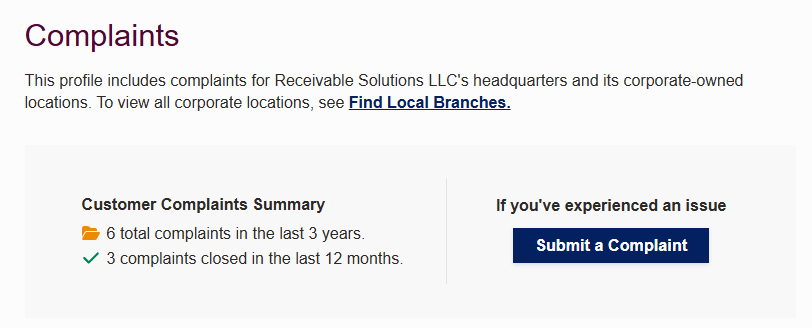
Receivable Solutions carries a C- BBB rating and is not accredited, and its file holds roughly thirty complaints over three years, most of them about billing and collection conduct. You can read the record on the company’s BBB complaints page. The recurring themes include:
- Relentless calling and robocalls. A BBB reviewer described how the company “rings my phone off the hook,” leaving an automated message that only identifies itself as a collection call. Consumers also report robocalls that continue even after a written request to stop.
- Collecting bills that were already paid. One reviewer recounted paying a bill, requesting a receipt, and never receiving proof, concluding that the operation seemed like “a scam.” Pursuing a paid balance is a false representation under the FDCPA.
- Refusal to verify the debt. Complaints describe asking the company to prove the debt and being met with continued pressure instead of documentation.
In our practice, the paid-bill complaint is among the most serious, because it means the calls and any credit reporting rest on money the consumer does not owe. That is precisely why the right to demand written validation matters so much here, and why a stream of automated messages is no substitute for an itemized statement and a receipt.
Consumer Reviews and Platform Reports
Because the review picture for Receivable Solutions is spread across many sites, here is what each platform actually shows, drawn only from listings tied to this Columbia, South Carolina agency rather than similarly named companies.
- BBB Reviews and Complaints: The strongest source. The company is unaccredited with a C- rating and roughly thirty complaints over three years, the majority about billing and collections. Reviews describe constant calling and automated messages.
- Yelp: Carries direct consumer reviews for the Columbia location, including the “rings my phone off the hook” automated-message complaint and the paid-bill, no-receipt review that called the company a scam.
- Google Reviews: Reflects the same themes reported elsewhere, with consumers describing rude representatives and persistent calls.
- Indeed and Glassdoor: Dozens of employee reviews describe a workplace that changed after the business was sold to a venture-capital owner, with production metrics becoming the central focus, useful context for the calling behavior consumers report.
- RevDex: Functions largely as a mirror of BBB complaint content, so the entries track the BBB record.
- ComplaintsBoard, Trustpilot, ConsumerAffairs, Sitejabber, MerchantCircle, PissedConsumer, and Ripoff Report: These platforms did not show a verified, dedicated page for this specific Columbia agency at the time of writing. Be cautious with results on these sites, because pages for differently named firms such as Global Receivables Solutions and Designed Receivable Solutions are separate companies and should not be attributed to Receivable Solutions, Inc.
One representative review captures the core grievance:
“The business rings my phone off the hook. It leaves an automated message saying it[‘s] collections.” (Consumer review of Receivable Solutions)
A complaint like that points to several legal exposures at once:
- An FDCPA harassment concern, because repeated calls whose natural effect is to annoy or abuse can violate the statute, which presumes a violation above seven calls about the same debt in seven days.
- A TCPA concern, because automated or prerecorded messages left on a cell phone without consent, especially after a request to stop, carry their own liability.
- An FDCPA validation and misrepresentation concern, because collecting a paid or unverified medical balance and refusing to provide a receipt misstates what is actually owed, implicating the rules against false or misleading representations.
Has Receivable Solutions Been Sued?
No publicly available federal court judgments or published opinions were found naming Receivable Solutions, Inc. (RSI) as a defendant in an FDCPA, TCPA, or FCRA lawsuit. However, the absence of a reported federal case does not mean every collection attempt is lawful or that consumers have no options.
Receivable Solutions has received consumer complaints involving medical debt collection issues, including disputes over billing accuracy, repeated collection calls, and difficulty obtaining documentation. These complaints reflect common concerns in medical debt collection, where insurance payments, billing errors, and account transfers can create inaccurate balances.
Our attorneys evaluate a potential claim on the specific conduct you experienced, such as robocalls after a stop request or the collection of a paid bill, rather than on whether a prior lawsuit matches your facts. A thinner court record does not weaken your case; it means your own documentation carries the weight.
What Calling and Collection Tactics Is Receivable Solutions Known For?
Drawing on the review record and the nature of medical-debt collection, the conduct consumers report around Receivable Solutions accounts sorts into four categories, each bounded by a legal limit.
- The defining complaint is a phone that rings constantly, often with a recorded message. Repeated calls whose natural effect is to harass violate the FDCPA, and automated messages to a cell phone without consent add exposure under the Telephone Consumer Protection Act, which allows damages of $500 to $1,500 per call.
- Consumers report robocalls that persist after they sent written requests to stop. Continuing to contact you about a debt after a proper written cease-and-desist is a straightforward FDCPA violation, and each later call can count separately.
- Reviews describe being pursued for balances that were already paid, sometimes with no receipt ever provided. Attempting to collect a debt that is not owed, or refusing to validate it, violates the FDCPA’s rules against false representations and unfair practices.
- Consumers report disputed or paid medical accounts on their credit files. Reporting a balance that is wrong, paid, below the credit bureaus’ thresholds, or not marked as disputed can violate the Fair Credit Reporting Act.
What Are Your Rights Against Receivable Solutions?
Because Receivable Solutions is a third-party collector working medical accounts, you have both the standard federal protections and safeguards specific to medical debt.
- Fair Debt Collection Practices Act (FDCPA): Receivable Solutions may violate the FDCPA by failing to provide proper debt validation, ignoring disputes, continuing collection after a valid cease-and-desist request, making false statements, attempting to collect inaccurate medical balances, or using excessive and harassing communication tactics.
- Telephone Consumer Protection Act (TCPA): Receivable Solutions may violate the TCPA by making automated or prerecorded calls to a consumer’s cell phone without proper consent, or by continuing robocalls after consent has been revoked.
- Fair Credit Reporting Act (FCRA) & Medical Debt Protections: Receivable Solutions may violate the FCRA by reporting inaccurate medical debts, failing to investigate disputes, or reporting medical collections that should not appear due to credit-reporting protections.
- South Carolina Consumer Protection Laws & State Protections: Receivable Solutions must comply with South Carolina’s consumer protection laws and the laws of the consumer’s home state. Unfair, deceptive, or misleading collection practices may violate these laws.
How to Stop Receivable Solutions From Calling You
Here is the step-by-step approach our attorneys use for a medical-debt collector that leans on constant calling.
Step 1: Demand an Itemized Bill and Log Every Call
On a medical account, documentation is your leverage, and a call log is your evidence.
- Request a fully itemized statement and proof that your insurance was applied, and do not pay on a verbal promise or an automated message alone.
- Keep a log of every call with the date, time, and number, including (803) 790-0446.
- Save all voicemails and automated messages, which are direct evidence of robocalling.
- Gather your own records: the provider’s bills, your explanation of benefits, and any proof of payment or requested receipt.
What our clients tell us is that setting the collector’s demand next to their own explanation of benefits is frequently what reveals the balance was never theirs to pay.
Step 2: Send a Written Validation Demand and Cease-and-Desist
Combine two messages into one certified letter. Send a debt validation request together with a cease-and-desist letter to the company at:
Receivable Solutions, Inc., 800 Dutch Square Blvd, Suite 140, Columbia, SC 29210
Confirm the address on your most recent collection notice before sending, and use certified mail with a return receipt so the date is documented. Because consumers report robocalls continuing after a stop request, every automated call that arrives after the company receives your letter can count as its own violation.
Step 3: Dispute the Debt and Any Credit-Report Entry
If the bill is wrong, already paid, or being reported inaccurately, challenge it in writing. Ask for the itemization and your explanation of benefits, and for any credit-report error, file a written dispute with each bureau and with Receivable Solutions to start the FCRA’s 30-day investigation clock. Check whether the entry is below the $500 medical threshold the bureaus no longer report, and keep copies of everything.
Step 4: Report the Conduct
Filing complaints builds an official record and often prompts a response. Submit yours to:
- CFPB
- FTC
- FCC
- BBB
- South Carolina Department of Consumer Affairs
Step 5: Talk to a Consumer Rights Attorney
If the calls keep coming, the bill is wrong, or your credit is affected, call us at (877) 700-5790 or open a free case review. We work on contingency, so there is no upfront cost, and the FDCPA’s fee-shifting provision means a collector that loses can be ordered to pay your legal fees. The conduct that most often supports a claim includes robocalls after a stop request, collecting a paid or unverified medical bill, harassing call volume, and inaccurate medical-debt reporting.

Consumer Rights Law Firm PLLC
Consumer Rights Law Firm PLLC is a law firm that specializes in helping clients who are facing harassment from debt collectors in any form, including telephone communication. Rather than suffer alone, contact our office to begin the process to stop the Receivable Solutions harassment. Our office has been assisting consumers since 2010. We have an A+ rating with the Better Business Bureau.
If you are interested in learning more about how to safeguard yourself and prevent harassment from Transworld, Inc. call us at (877)700-5790 for immediate assistance or visit our website.
Success Stories
- I can’t believe how friendly and fast Matt acted on my behalf. The collection calls stopped quickly and my debit for that card is GONE. The firm got the card company to forgive my balance and even pay their fees. I didn’t have to pay anything. The best call I could have made. Thank you
- Had a scammer call me today trying to scam me out of almost $3k for a past bill for my ex-husband. After calling and emailing me all afternoon with the demand I pay it I contacted the Consumer Rights Law Firm for guidance. I received quick and helpful advice which confirmed my suspensions that it was a scam. Thank you for your quick and reassuring advice!
- Absolutely amazing experience, Matt really helped me to get one of my bills removed due to the harassment I received from said company of the bill. Phone calls stopped, didn’t cost me anything out of pocket! I would highly recommend using this service. Real deal y’all!