
A Navient-related call in 2026 may not actually be coming directly from Navient. MOHELA replaced the company as the routine borrower-facing servicer for transferred student loans in 2024, while Navient can still remain connected to the loan as owner or master servicer.
That matters after a transfer, during payment relief, after an apparent payoff, or when a cosigner is contacted. The first question is whether the caller’s account status matches the consumer’s records.
In our practice, we start by lining up the final Navient statement, the MOHELA transfer notice, the first new servicing statement, and the call history. Borrowers often use one company name for several different roles. Identifying the loan owner, current servicer, and actual caller tells us where the account-status investigation needs to begin.
Why Is MOHELA Calling Me About My Navient Student Loan?
MOHELA may be calling because it replaced Navient as the consumer-facing servicer for transferred student loans, even though the company can remain connected to the underlying loan.
The transfer was not a merger. Consumers should compare the transfer notice, current statement, and ownership information before assuming the debt was sold.
Did MOHELA Buy My Navient Loan?
No. The verified company information says MOHELA replaced Navient as servicer but did not buy or merge with the company.
That distinction separates loan ownership from routine servicing.
Why Am I Still Getting Calls If My Loan Is Deferred, in Forbearance, or Transferred?

Calls can continue when the servicing system shows a status that differs from what the consumer believes applies to the loan.
According to BBB complaints, some consumers reported payment-related calls while they believed an account was deferred or in forbearance. Those reports are allegations, but approval dates and account history matter.
For these files, the decisive comparison is often between the written relief approval and the dates the account was treated as payable. We place the approval period beside billing dates, delinquency history, and calls. That timeline can show whether the disagreement concerns an expired status, an unapproved request, or a servicing record that does not match the consumer’s documents.
Why Does My Account Show $0 If Someone Still Says I Owe Money?
A $0 display does not by itself prove that a student loan was paid, forgiven, or discharged.
A servicing transfer or movement into another recovery channel can change what appears on one account screen. A published BBB complaint alleged this type of post-transfer confusion.
The key records are the final statement, transfer history, payoff documents, and any later recovery notice.
Why Does My Student Loan Balance Still Look High After Years of Payments?
A high remaining balance can reflect interest, capitalization, interest-only periods, deferment, or forbearance, so the records must be reconstructed before assuming an error.
With older private student loans, we work from the promissory note forward. The lifetime payment ledger, interest-rate history, capitalization events, and periods of reduced or suspended payment show where the balance came from. Only after reconstructing that history can we separate a surprising balance from an amount the loan records do not explain.
What If the Calls Are Going to My Cosigner Instead of Me?
Calls to a cosigner should be documented separately because the recipient, telephone number, contractual liability, and communication history can differ from the primary borrower’s.
That point was central in Blume v. Navient Corporation and Navient Solutions, LLC. The plaintiff alleged repeated automated cosigner calls, but the federal TCPA claim was dismissed because the plaintiff was not the relevant called party. State claims were remanded.
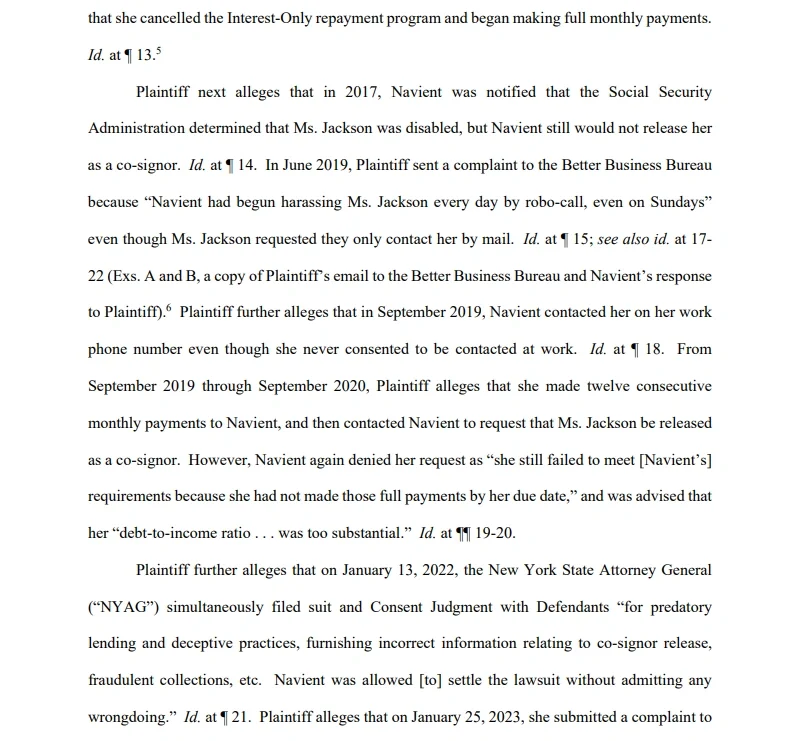 In a cosigner file, we separate each receiving number, subscriber, voicemail, and release record before evaluating the calls. Families may understandably count every contact together, but Blume shows why recipient identity matters. A call-by-call timeline lets us determine which communications belong to the borrower and which belong to the cosigner.
Why Can Calls Continue When the Account Status Looks Wrong?
Calls may continue because the servicing system treats the account as delinquent or otherwise payable even though the consumer believes a different status applies.
The BBB profile reports an A+ rating, BBB accreditation since September 15, 2022, and complaints generally displayed over a three-year period. Published narratives include allegations involving deferment, forbearance, transfer confusion, recovery placement, payoff, balances, and cosigners.
The CFPB’s historical case against the company also involved allegations concerning forbearance, repayment administration, payment processing, cosigner release, and credit reporting. The case ended in a 2024 stipulated judgment rather than a trial finding establishing every allegation.
What matters in an individual file is the account history. A servicing transfer, forbearance expiration, payment posting, or movement into recovery can change the status driving communications. We match those account events against the call dates to identify where the consumer’s documents and servicing history first stop agreeing.
What Should I Gather Before Responding to Navient-Related Calls?
You should gather records that identify the loan, current servicer, account status, and actual caller before deciding how to respond.
| Record | What It Can Show |
| Promissory note | Whether the loan is private or FFELP |
| Transfer notice | When borrower-facing servicing changed |
| Final and current statements | Balance and status before and after transfer |
| Deferment or forbearance approval | Whether relief covered the call dates |
| Payoff records | Whether the account was satisfied |
| Call log and voicemails | Who called, when, and which number received the call |
These records can also show whether the same disputed status appears in payment demands, servicing history, and credit reporting.
How Can I Contact Navient About My Account?
You can use the verified company contact information below, although routine servicing for transferred student loans is generally handled by MOHELA.
| Item | Details |
| Student-loan servicing phone | 1-800-428-1039 |
| Website | navient.com |
| Principal executive office | 13865 Sunrise Valley Drive, Herndon, VA 20171 |
Use independently obtained official contact information when verifying an unexpected call.
How Can Consumer Rights Law Firm PLLC Help With a Navient-Related Call?
Consumer Rights Law Firm PLLC can evaluate a Navient-related call when the caller identity, account status, servicing transfer, balance, or cosigner history does not match the consumer’s records.
Clients may arrive with a transfer notice, payoff document, credit report, or call log but no single timeline tying everything together. We organize the loan type, servicing history, disputed status, and communications first. That helps identify which additional records matter before deciding how the account or calls should be addressed.
| Contact | Details |
| Phone | +1 (877) 700-5790 |
| Website | consumerlawfirmcenter.com |
| help@consumerlawfirmcenter.com | |
| Mailing address | 133 Main Street, Second Floor, North Andover, MA 01845 |
| Fax | 844-636-9909 |
| Better Business Bureau | CRLF Better Business Bureau Profile |
Success Stories
I reached out needing help. Scott contacted me right away and reassured me everything was going to be ok. And took care of all my worries. He was an amazing help and I’m grateful for his service. And they guaranteed I would not have to pay a dime. Very thankful.
Derek and Matt, are some of the best people I’ve ever met. I had a bad situation which they were quickly able to help get resolved. The open communication and fast response time, along with their patience and vast knowledge really helped ease my mind and confirm I made the right choice. Thank you Consumer Rights Law Firm!
Scott was soo very helpful in getting this resolved for me. I had a nasty collection agency call me & harass me & my family. I reached out to this company & he got it resolved in no time. They also never asked me for any money out of pocket what so ever either which was a bonus. What did I have to loose?! Check them out if being harassed or threatened by a collection agency. Thank you again Scott for all your help. Stay safe!!!!
What Questions Should I Answer Before Disputing Navient-Related Calls?
Before disputing the calls, identify who services the loan, what account status applies, and which person or telephone number actually received each communication.
Can Navient Still Call Me After My Loan Moved to MOHELA?
It depends on who is actually calling and what role each entity has, so caller identity and servicing records should be checked first.
Why Is MOHELA Contacting Me About a Private Student Loan?
MOHELA can service transferred private student loans even though many consumers associate the company primarily with federal loans.
Does Having MOHELA as My Servicer Mean My Loan Is Federal?
No. The transferred portfolios can include private education loans and privately held FFELP loans.
Why Am I Getting Calls After Requesting Deferment?
A request does not necessarily prove that deferment was approved for the dates when the calls occurred.
Why Am I Getting Calls During Forbearance?
The approval period, expiration date, and servicing status should be compared with the call dates.
Why Does One Account Show $0 While Another Company Wants Payment?
A zero display can reflect a transfer or movement to another channel rather than a documented payoff or discharge.
Can My Cosigner Be Called About My Student Loan?
A cosigner may receive calls while remaining contractually responsible for the loan unless a formal release changed that obligation.
What If I Already Told the Company to Stop Calling Me?
Preserve the request and identify which entity received it because servicing responsibilities changed after the transfer.
How Do I Know Whether a Navient-Related Call Is Legitimate?
Verify the caller independently against official account and servicing information before relying on the number provided in the call.
What Records Should I Review Before Disputing the Calls?
Start with the promissory note, transfer notices, current statements, status approvals, payoff records, and a detailed call log.