
The name Logistical Recovery Systems may appear on a collection demand, but the first questions are who is actually seeking payment and what transaction created the balance. The historical business specialized in commercial transportation and logistics collections, not ordinary consumer credit accounts.
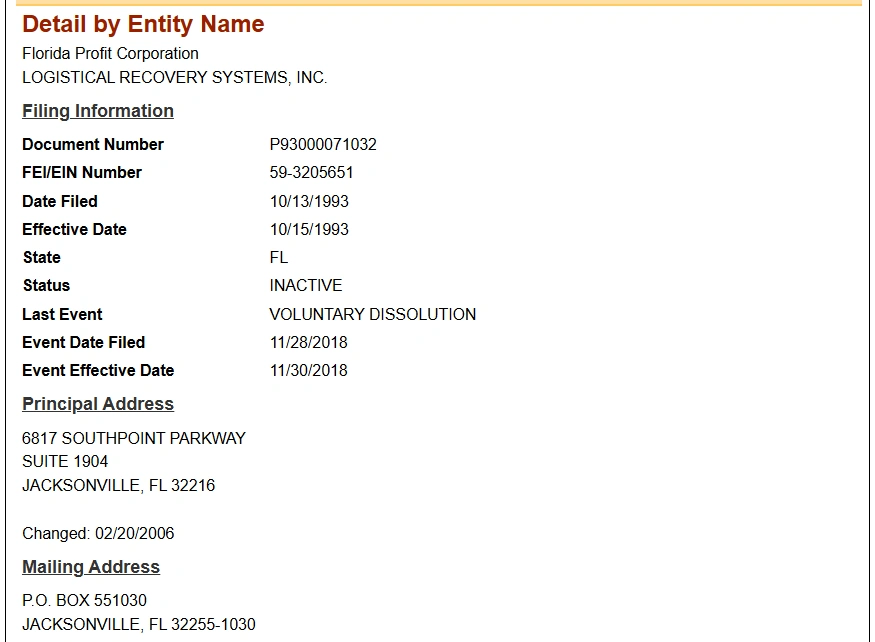
Florida records show that Logistical Recovery Systems, Inc. dissolved effective November 30, 2018. Logistical Collection Services LLC is a separate active company operating in commercial receivables and logistics collections, with personnel overlap between the two businesses. Do not assume the active company is the legal successor to the former corporation simply because the businesses share personnel and a similar niche.
Before responding, identify the current caller, original creditor, account purpose, amount claimed, and records supporting that amount.
Why Is Logistical Recovery Systems Contacting You, and Which Company Is Actually Calling?
A current collection communication should be traced to the legal entity actually making the demand, not identified only by an old company name or internet listing.
Florida corporate records show that Logistical Recovery Systems, Inc. is inactive. Logistical Collection Services LLC, by contrast, is an active Florida company that describes itself as a commercial receivables company offering first-party and third-party collection services.
Look at the collection letter, caller phone number, email domain, payment instructions, and company address. Those details may identify the historical name, Logistical Collection Services, the original creditor, or another actor.
One of the first things we examine in a file like this is whether the company requesting payment matches the entity identified in the written account records.
What Creditor, Freight Invoice, or Business Account Is Behind the Collection Demand?
The next step is to identify the creditor and the exact transaction behind the balance.
Historical descriptions connect Logistical Recovery Systems to commercial transportation and logistics collections. The account may therefore involve a freight invoice, transportation charge, logistics service, commercial account, or related business obligation rather than a personal credit account.
Compare the collection communication with:
| Record | Why It Matters |
| Original contract or service agreement | Shows what service or obligation created the account and who agreed to pay it. |
| Invoice or freight bill | Shows the amount originally billed and the creditor involved. |
| Payment history | Helps determine whether payments were credited before the account was placed for collection. |
| Credits, adjustments, or offsets | May explain why the amount demanded differs from the original invoice. |
| Personal guaranty, if any | Shows whether an individual signed a written promise to be responsible for a business obligation. |
The goal is to connect the collection demand to a specific account rather than treating the caller’s balance as automatically correct.
Is the Logistical Recovery Systems Account a Commercial Debt or a Consumer Debt?
The account’s original purpose determines whether federal consumer debt collection protections may apply.
For a covered third-party collector, the Fair Debt Collection Practices Act generally applies only when the obligation was incurred primarily for personal, family, or household purposes. CFPB guidance on FDCPA coverage explains that ordinary business debts fall outside that definition.
That distinction matters here because the documented business model centered on commercial logistics and transportation receivables. A call to your personal cellphone does not by itself turn a business obligation into consumer debt. An individual may also be contacted because they signed a guaranty for a business account.
What matters first is why the debt was originally incurred, not simply who answered the phone.
What Should You Compare Before Paying or Disputing the Amount?

Before paying, reconstruct how the amount moved from the original account balance to the amount now being requested.
Compare the creditor’s records with the collection demand. Look for payments made before or after collection placement, credits or adjustments, disputed freight or service charges, offsets, settlement communications, and documents identifying who currently owns or has authority to collect the account.
Historical descriptions show the business handling accounts placed by clients, so do not assume the collector bought or owns the debt.
We often compare the creditor’s ledger with the collector’s current balance because a missing payment, credit, or adjustment can change what the consumer or business actually owes.
What Should You Document About Calls and Other Collection Communications?
Keep a clear record of every communication before deciding whether the calls create a separate legal issue.
Save call dates and times, phone numbers, screenshots of call history, voicemails, recorded or computer-generated messages, representative names, company names stated during calls, letters, emails, and any request you made about future communications.
These records help separate three questions: who called, what account the communication concerned, and how the caller communicated.
If you believe repeated calls are improper, the call history matters more than memory alone. If a prerecorded or artificial voice was used, preserve the audio because federal telephone law may require a different analysis from ordinary debt collection rules.
Which Collection and Telephone Protections May Apply to Your Situation?
The applicable law depends on the actor, the type of debt, and the way the communication occurred.
If a covered third-party collector is collecting a qualifying personal, family, or household debt, the FDCPA and Regulation F may be relevant. CFPB guidance explains that Regulation F includes presumptions concerning repeated telephone calls about a particular consumer debt. Those rules should not automatically be applied to a commercial freight or logistics account.
Florida separately regulates commercial collection activity. Its commercial collection statute defines commercial claims as obligations arising primarily from business transactions, including certain obligations of guarantors and sureties.
Telephone law may present a separate issue. Under the Telephone Consumer Protection Act, certain calls using regulated automated or prerecorded technology may be restricted depending on the number called, the technology used, consent, and other circumstances.
Legal analysis should follow the facts, not the label “debt collector.”
Historical Logistical Recovery Systems and Current Logistical Collection Services Contact Information
The historical phone and address below should not be treated as current. The Logistical Collection Services details belong to a separate active company and should be used only when your collection documents identify that company.
| Item | Details |
| Historical phone | (904) 296-3308, historical status only |
| Historical address | 6817 Southpoint Parkway, Suite 1904, Jacksonville, FL 32216 |
| Logistical Collection Services phone | (904) 423-0021 |
| Logistical Collection Services address | 9310 Old Kings Road S, Suite 403, Jacksonville, FL 32257-8103, as listed on its website |
| Website | logisticalcollections.com |
| support@logisticalcollections.com |
The current Logistical Collection Services contact information does not, by itself, prove that it is the legal successor to the dissolved corporation. Match the contact details against the documents you received before sending payment or sensitive account information.
When Should I Consider Legal Help With This Account?
Legal review may be useful when the caller’s identity is unclear, the amount does not match the creditor’s records, you dispute personal responsibility for a commercial account, or the calls themselves raise a separate communication issue.
Consumer Rights Law Firm PLLC may compare the collection communication, account documents, payment history, guaranty, call records, and any credit-report information to determine which actor is involved and which legal framework may apply.
| Item | Details |
| Phone | +1 (877) 700-5790 |
| help@consumerlawfirmcenter.com | |
| Website | consumerlawfirmcenter.com |
| Address | 133 Main Street, Second Floor, North Andover, MA 01845 |
| Fax | 844-636-9909 |
| Better Business Bureau | CRLF Better Business Bureau Profile |
Success Stories
I really didn’t know what to expect when I called this office after my family and I were harassed by JPL Recovery solutions. I left them a message and they called me back, and I couldn’t believe how helpful they were from beginning to end! They were able to get me full debt relief for what I owed to JPL and my account was closed with a zero balance for all the harassment! Do not hesitate to call these guys, they are extremely helpful and great at what they do!
They are so awesome and treat you like a human being. From the minute I called them and explained how this debt collector harassed me and said things that were so illegal they jumped right on it and started helping me. Its good to know they’re still people out here in this world that actually care about people. Thanks for everything and God bless you guys.
Matthew Gazda and his team did a great job helping me with my harassment with a bank I am beyond grateful and would definitely would recommend them to anyone I know. I would definitely use their service again if i have any other issues in the future.
Frequently Asked Questions
Is Logistical Recovery Systems a debt buyer?
Historical descriptions show the business collecting accounts placed by clients rather than documenting a debt-buying model. Check the collection notice and creditor records to identify who currently owns the account.
Can I Be Personally Responsible for a Business Debt If I Signed a Guaranty?
Possibly. A guaranty is a written promise to become responsible for another party’s obligation under stated conditions. Personal liability does not automatically mean the underlying business debt becomes a consumer debt.
What If an Account Tied to This Collector Appears on My Credit Report?
Identify the company actually furnishing the information and compare the reported balance, status, creditor, and account details with your records. A credit-report dispute is separate from a dispute over the underlying account or collection calls.
What If I Never Signed a Personal Guaranty for the Business Account?
Review the contract, account application, and any document the creditor relies on to claim personal liability. The business owing money and an individual owner personally owing it are separate questions that should be supported by the account documents.