




If you’ve ever watched a single overdraft spiral into dozens of dollars in fees—and then found your phone ringing off the hook from your bank’s collection department—you’re not alone. Overdraft fees remain one of the most frustrating aspects of modern banking, and when left unpaid, they can trigger aggressive collection tactics that sometimes cross legal lines.
This guide breaks down exactly how overdraft and NSF fees work in 2025, what banks can legally do to collect, and how to protect yourself when collection efforts feel more like harassment than legitimate debt recovery.
Key takeaways: overdraft fees, collections and harassment
Before diving into the details, here’s what you need to know right now if you’re dealing with overdraft-related pressure from your bank.
- Average overdraft fees in 2025 range from about $26 to $30 per item, though some banks still charge up to $35–$36. Multiple transactions in a single day can rack up fees quickly—some banks allow up to three to five overdraft fees per business day.
- Several major banks have eliminated overdraft fees entirely. Ally Bank, Capital One, Citibank, and Chime no longer charge overdraft fees on their primary checking accounts. Others like Wells Fargo, Chase, and Regions Bank still charge around $34–$36 per overdraft.
- Unpaid negative balances can trigger collection calls within weeks and account closure within 30–60 days. After 60–90 days, many banks charge off the debt and sell it to third-party collectors who may report to credit bureaus.
- Aggressive collection tactics may violate federal and state law. The Fair Debt Collection Practices Act restricts what third-party collectors can do, and state consumer protection laws can apply to bank collection departments.
- You have options. This article covers how overdraft fees work, what your bank can legally do, how to respond to harassment, and how to switch to financial institutions that won’t hit you with surprise charges.
How overdrafts and NSF fees really work in 2025
Understanding the mechanics behind overdraft charges is the first step to avoiding them—and to pushing back when your bank account goes negative.
An overdraft occurs when you make a purchase, write a check, or authorize an ACH transaction that exceeds your available balance, and your bank pays the transaction anyway. The bank essentially loans you the difference, then charges you a fee for the privilege. This is different from a nonsufficient funds (NSF) fee, which is charged when your bank declines a transaction because you don’t have enough money in your account. With NSF, the payment bounces; with an overdraft, it goes through—but you pay for it.
Here’s the typical sequence when your balance drops below zero:
- You swipe your debit card or authorize a bill payment that exceeds your available funds
- Your bank checks your overdraft coverage status and decides whether to approve or decline
- If approved as an overdraft, the bank pays the merchant and charges you an overdraft fee. Banks may choose to pay overdrafts at their discretion, and the costs for these overdraft transactions can vary depending on your bank’s policies and the type of account you have.
- If declined, you may face an NSF fee (though many banks have eliminated these) and the merchant may also charge you a returned payment fee
The fee amounts vary significantly across banks and credit unions:
- Overdraft fees typically range from $10 to $36 per item. Bank of America charges just $10 (max 2 per day), while U.S. Bank charges $36 (max 3 per day).
- NSF fees are often $0 to $15 at banks that still charge them. Many financial institutions have eliminated insufficient funds fees entirely following pressure from the .
- Continuous negative balance fees (sometimes called “extended overdraft fees”) can add $5–$7 per day if your account stays negative for several days.
Many banks now offer small overdraft buffers that help you avoid overdraft fees on minor miscalculations. U.S. Bank and Huntington Bank both offer $50 buffers, meaning you won’t be charged unless you’re more than $50 overdrawn. KeyBank offers a $20 buffer, and Santander provides a $100 cushion. Some banks also give you a one-business-day grace period to bring your account to a positive balance before the fee posts. These features are designed to help customers avoid paying overdraft fees on small overdraft transactions.
Here’s how fees can compound quickly. Imagine your checking account has $40 and you forget about three automatic payments totaling $85. If your bank processes all three as overdrafts at $35 each, you’re suddenly looking at $105 in fees on top of the $45 you were short. Multiple overdraft transactions in a short period can result in significant cumulative fees, making it even more important to monitor your account activity. Leave that account negative for a week with daily continuous fees, and you could owe $150+ before any collection efforts even begin.

Overdraft and NSF fees by major banks and credit unions
Overdraft policies vary dramatically across financial institutions. Many banks offer overdraft services as part of their personal checking accounts, with varying features and fees. The comparison below reflects 2024–2025 policies, though banks update their terms frequently—always verify current terms in your deposit account agreement before making decisions.
Low-fee and no-fee institutions:
- Alliant Credit Union eliminated overdraft and NSF fees in 2021. Their Courtesy Pay program covers transactions up to $100, but requires immediate repayment. Members with eligible direct deposits can access up to $250 in fee-free overdraft coverage. Some banks, including Alliant, provide an overdraft protection service, such as linked account transfers or fee waivers, to help customers avoid negative balances.
- Ally Bank stopped charging overdraft fees in June 2021. Instead of paying overdrafts and charging you, Ally simply declines debit card transactions when you lack available funds. Their CoverDraft program provides up to $250 in fee-free overdraft coverage for qualifying customers based on deposit history.
- Bank of America eliminated NSF fees and reduced its overdraft fee to $10 in 2022—down from $35. They cap fees at 2 per day and offer Balance Connect, which automatically transfers funds from a linked savings account with no transfer fees.
- Capital One charges no overdraft or NSF fees on 360 Checking accounts as of 2022. Their free automatic transfer service pulls from a linked account to cover transactions, completely eliminating overdraft protection transfer fees.
- Citibank eliminated overdraft fees, overdraft protection fees, and NSF fees in mid-2022, making it the largest U.S. bank to fully drop overdraft charges. Transactions that would overdraw your account are simply declined.
- Chime (online bank) offers SpotMe, allowing eligible users to overdraft on debit card purchases up to approximately $200 with no fees. Limits depend on your direct deposit history and account usage.
Personal checking accounts at these institutions often come with different overdraft services and protection options, such as overdraft protection service programs, fee waivers, or linked account transfers.
Higher-fee traditional banks:
- Wells Fargo charges $35 per overdraft item as of late 2024, with a daily cap on fees. Their Extra Day Grace feature gives you until 11:59 p.m. ET the next business day to bring your account to $0 and avoid the fee. Optional overdraft protection from a linked account is available.
- U.S. Bank charges $36 per overdraft paid, up to 3 fees per day, but only when your account is more than $50 overdrawn. Their “Overdraft Fee Forgiven” program waives fees if you bring your balance to zero by 11 p.m. ET the same day.
- Regions Bank eliminated NSF fees in 2022 but still charges around $36 for overdrafts, with a 3-per-day cap. Their Overdraft Grace feature extends repayment through the next business day before fees apply.
- Chase charges $34 per overdraft with a daily limit. They’ve added a $50 overdraft buffer, meaning small overdrafts under $50 don’t trigger fees.
Personal checking accounts at these banks may include various overdraft services, such as overdraft protection service options, overdraft buffers, or linked account transfers.
Online and fintech alternatives:
- SoFi and Charles Schwab Bank do not charge overdraft fees on their checking accounts and simply decline everyday debit card transactions that exceed your balance.
- Varo and Current offer similar fee-free models with small overdraft buffers for qualifying accounts.
- Most credit unions have more favorable overdraft terms than large banks, with many offering lower fees or courtesy coverage programs.
When discussing linked accounts for overdraft protection, note that money market accounts can also be linked for overdraft protection, providing another way to avoid fees.
From fee to fallout: collections, ChexSystems and account closures
A single $35 overdraft fee might seem manageable, but when left unaddressed, it can quickly escalate into something that affects your ability to open bank accounts for years.
Here’s a realistic timeline of how overdraft debt spirals:
Week 1–2: The overdraft occurs and your bank posts the fee. If your account stays negative, you may see additional continuous negative balance fees ($5–$7 per day at some institutions). Your bank sends emails and letters warning you to bring the account positive. Some banks restrict your debit card or online banking access.
Around 30–60 days: If your account remains negative, the bank typically freezes or closes it. Internal collections ramps up with more frequent calls and letters. Any incoming direct deposit may be applied to the negative balance before you can access it. Your account linked to automatic payments stops working, potentially triggering declined transactions and other fees elsewhere.
Around 60–90 days: Banks usually charge off the negative balance as a loss and either pursue it through internal recovery or sell/assign the debt to a third-party collection agency. At this point, the original $70 overdraft might have grown to $250+ after fees, and now a collector owns it.
ChexSystems and Early Warning Services reporting:
When a bank closes your account with an unpaid negative balance, they typically report this to ChexSystems, Early Warning Services, or similar account-screening bureaus. This creates serious problems:
- Negative records can remain on your ChexSystems report for up to 5 years
- Most banks and credit unions check these databases before opening new accounts
- A negative report can result in automatic denial for most checking accounts and some savings account applications
- You may be limited to “second chance” banking products with higher fees and fewer features
Credit bureau impact:
Overdraft fees themselves are not loans and don’t appear on your credit report. However, once a charged-off negative balance goes to a debt collector, that collector can report the debt to Experian, Equifax, and TransUnion as a collection account. This can damage your credit score and remain visible for up to seven years.
For example: You overdraft by $45, get hit with a $35 fee, then a $7/day continuous fee for 10 days. Your $45 shortage is now $150. The bank closes your account and sells the debt. A collector adds their own fees, and now you have a $250 collection account on your credit report—all from one forgotten bill payment.
When bank collection tactics become harassment
There’s a meaningful difference between a bank legitimately trying to recover money you owe and a collection operation that crosses into unlawful harassment. Understanding where that line falls can help you push back effectively.
Legal frameworks that protect you:
The Fair Debt Collection Practices Act (FDCPA) governs third-party debt collectors—companies that purchase or are assigned debts from original creditors. Under the FDCPA, collectors cannot:
- Call you before 8 a.m. or after 9 p.m. in your local time zone
- Contact you at work if you’ve told them your employer prohibits such calls
- Use profane language, threats of violence, or false statements
- Discuss your debt with third parties (family, roommates, employers) without your permission
- Threaten arrest, criminal prosecution, or deportation over a civil debt
The FDCPA applies to third-party collectors, not necessarily to your bank’s internal collection department. However, state unfair or deceptive acts and practices (UDAP) laws often do apply to banks directly and can provide similar protections.
Examples of potentially unlawful harassment:
- Your bank’s collection department calls you four times in a single afternoon after you’ve requested in writing that they limit contact
- A collector threatens to have you arrested for writing a bad check when you simply overdrew your debit card
- Someone from collections calls your workplace repeatedly after you’ve informed them your employer prohibits personal calls
- A collector tells your spouse or parent details about your overdraft debt without your consent
- You receive threatening voicemails implying criminal consequences or immigration problems
Legitimate (though uncomfortable) collection conduct:
Not all unpleasant collection activity is illegal. Banks and collectors are generally allowed to:
- Call you occasionally during normal business hours
- Send written notices about charge-offs, placement with collection agencies, or ChexSystems reporting
- Offer payment plans or settlement discounts
- Report accurate information to ChexSystems or credit bureaus
- File a civil lawsuit to recover the debt (though this is rare for small overdraft amounts)
If Wells Fargo’s internal collections calls you once a day during business hours with payment reminders, that’s likely legal even if annoying. If they call you eight times in one day, leave threatening voicemails, and continue after you’ve sent written notice to stop, that’s a different situation entirely.

How to respond when you’re being harassed over overdraft or NSF fees
If collection calls have become overwhelming—or if collectors are using tactics that feel threatening or illegal—you have concrete steps you can take today.
Immediate protective actions:
- Stop answering calls from unknown numbers. Let calls go to voicemail and document what’s said.
- Require all contact in writing when possible. This creates a paper trail and slows down aggressive callers.
- Keep a detailed log of every call: date, time, phone number, name of caller, what was said, and any threats made.
- Save all voicemails, letters, text messages, and emails. Screenshot everything and store copies in multiple places.
Send a written cease-and-desist letter:
For third-party debt collectors (not your bank’s internal department), the FDCPA gives you the right to demand they stop calling. Send a letter via certified mail stating:
- Your name and the account number they’re referencing
- That you are requesting all future contact be made in writing only
- That you dispute the debt amount (if applicable)
- That continued phone calls after receiving this letter will be considered harassment
Keep a copy of the letter and the certified mail receipt. If calls continue, you have documented evidence of a potential FDCPA violation.
Dispute incorrect amounts:
If you believe the fees are wrong—perhaps you were charged during a bank’s advertised grace period, or you see duplicate fees—take action:
- Request a detailed account history showing each overdraft and every fee
- Review your bank statements for timing of transactions versus when fees posted
- Identify any fees that violate the bank’s stated policies (charged within a buffer period, for example)
- Send a written dispute to the bank requesting correction and a courtesy reversal
Many banks will waive fees once as a courtesy if you have a clean history. It never hurts to ask, especially in writing.
Escalation paths when harassment continues:
- Contact your bank’s executive customer service or “office of the president” team. This escalates beyond frontline collectors.
- File a complaint with the Financial Protection Bureau CFPB at consumerfinance.gov. The CFPB forwards complaints to banks and tracks patterns of abuse.
- File a complaint with your state attorney general’s consumer protection division.
- Consult a consumer rights attorney or legal aid organization, especially if you’ve received lawsuit threats or wage garnishment notices.
Consider settling quickly:
Sometimes the most practical path is negotiating a reduced payoff. If you owe $200 and the bank is willing to accept $100 to close the matter, paying immediately may cost less than years of damaged banking history and collection calls. Ask for:
- A fee waiver in exchange for paying the original overdraft amount
- A reduced settlement amount (often 50–70% of the total)
- Written confirmation that payment satisfies the debt in full
Get any settlement agreement in writing before sending money.
Preventing overdrafts with account alerts
One of the most effective ways to avoid overdraft fees is by taking advantage of account alerts offered by many financial institutions. Banks and credit unions now provide a range of customizable alerts that notify you when your checking account or savings account balance drops below a certain threshold. These low balance alerts give bank customers a crucial heads-up, allowing you to transfer funds, deposit money, or adjust upcoming automatic payments before an overdraft occurs.
Account alerts can be set up for a variety of activities, including debit card transactions, ATM transactions, and recurring debit card transactions. You can choose to receive notifications for large transactions, potential overdrafts, or even when your available balance is running low. Most financial institutions let you receive these alerts via email, text message, or through their online banking and mobile app platforms, so you’re always in the loop about your account activity.
In addition to alerts, many banks and credit unions offer overdraft protection services. These services typically allow you to link a savings account, money market account, or even a line of credit to your checking account. If your account balance isn’t enough to cover transactions, funds are automatically transferred from your linked account to prevent an overdraft. While some banks charge overdraft protection transfer fees, these are usually much lower than standard overdraft fees or NSF fees. Some institutions even waive these transfer fees or offer annual overdraft fee savings programs, helping you keep more money in your account.
The (CFPB) has played a key role in protecting consumers from unnecessary overdraft fees. The CFPB requires financial institutions to obtain your explicit consent before enrolling you in debit card overdraft coverage for ATM and everyday debit card purchases. They also encourage banks and credit unions to provide clear, transparent information about overdraft protection options and associated fees, so you can make informed decisions about your banking services.
To maximize your protection, set up multiple types of alerts—such as low balance alerts and large transaction notifications—and regularly review your account statements for any unexpected charges, including maintenance fees or ATM fees. If you use overdraft protection, make sure you understand any transfer fees and how your linked savings account or line of credit will be used to cover transactions.
Some financial institutions go even further, offering NSF fee waivers, linked account overdraft protection, and special programs for annual overdraft fee savings. Credit unions, in particular, often provide more consumer-friendly options and lower fees than traditional banks.
Ultimately, preventing overdrafts is about combining smart account management with the right tools. By setting up account alerts, using overdraft protection services wisely, and staying on top of your account balance, you can avoid overdraft fees, maintain a positive balance, and protect your financial well-being.
Smart ways to avoid overdrafts and fee traps going forward
The best defense against future harassment is preventing overdrafts from happening in the first place. These tactics can significantly reduce your exposure. Many financial institutions are also actively reducing overdraft fees by eliminating or minimizing these charges, making banking more affordable for customers.
Adjust your overdraft coverage settings:
- Turn off “courtesy” debit card overdraft coverage for ATM transactions and everyday debit card transactions. Without this coverage, your card is simply declined at the register instead of approved and fee-charged. Federal rules require banks to get your opt-in before covering these transactions.
- Keep standard overdraft coverage active only for checks and recurring debit card transactions where a decline could cause bigger problems (like a bounced rent check).
Set up alerts and monitoring:
- Enable low balance alerts in your bank’s mobile app. Set the threshold at $50–$100 so you have warning before problems arise.
- Turn on transaction notifications for every debit card purchase. Real-time awareness prevents surprises.
- Review your available balance regularly—remember that pending transactions may not show in your account balance until they post.
Use overdraft protection wisely:
- Link a savings account for overdraft protection transfers. Most banks charge $0–$12 per transfer, far less than a $35 overdraft fee. Bank of America and Capital One offer this with no transfer fees.
- Avoid using a line of credit or credit card as overdraft protection unless absolutely necessary—interest charges can add up. Using a line of credit or credit card for overdraft protection typically requires credit approval and eligibility based on your creditworthiness.
- If your bank offers an overdraft line, understand the terms before relying on it.
Take advantage of bank tools:
- Wells Fargo’s Extra Day Grace gives you until the next business day to cover transactions
- U.S. Bank Overdraft Fee Forgiven waives fees if you bring your balance to zero by 11 p.m. the same day
- PNC Low Cash Mode gives you 24 hours to address a negative balance before fees hit
- Early direct deposit (Chime, Citizens Paid Early, and others) can give you access to your paycheck up to two days early, helping you cover upcoming automatic payments before they trigger overdrafts
Track recurring charges:
- Review your bank statements monthly for subscription renewals and annual charges you may have forgotten
- Set calendar reminders before annual subscription renewals hit
- Keep a list of all bill payments with their dates and amounts so nothing surprises you
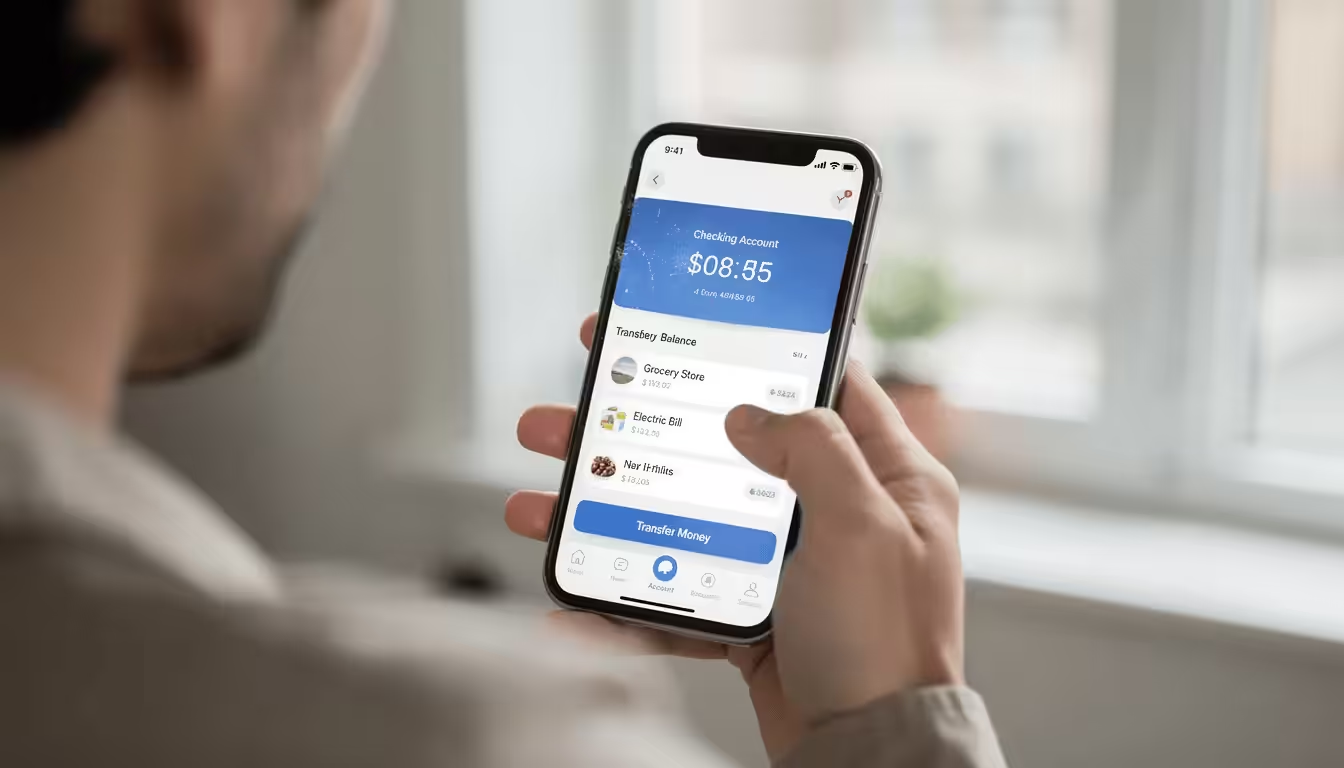
Considering a switch: banks and accounts that minimize overdraft risks
If your current bank has repeatedly hit you with overdraft or NSF fees—or allowed aggressive collections over small balances—it might be time to switch to a more consumer-friendly option.
What to look for in a new bank account:
- No overdraft or NSF fees, or very low fees with meaningful buffers
- Automatic transaction declines for debit card purchases instead of fee-based overdrafts
- Free overdraft protection transfers from a linked savings account
- Early direct deposit options that align your paycheck with bill due dates
- Strong mobile alerts and real-time transaction notifications
- No monthly maintenance fees (or easy ways to waive them)
Fee-free and low-risk options as of 2024–2025:
- Neobanks like Chime, Current, Varo, and SoFi offer checking products with no overdraft fees. Chime’s SpotMe provides fee-free overdraft coverage up to $200 for qualifying direct deposit customers.
- Traditional banks with “safe” accounts that simply do not allow overdrafts: Wells Fargo Clear Access Banking and Truist Confidence Account decline transactions that would overdraw your account rather than charging fees.
- Credit unions like Alliant and BECU have eliminated or sharply reduced overdraft-related fees and often offer more personal service when problems arise.
- Online banking options like Charles Schwab Bank checking come with no overdraft fees and ATM fee rebates.
Steps to switch smoothly:
- Open the new account before closing the old one. Don’t close your current account until everything is transitioned.
- Move your direct deposit to the new account. Update the routing and account numbers with your employer’s payroll department.
- Transfer automatic payments one by one. Update your debit card information for subscriptions and brokerage accounts, and change ACH payment details for bill payments.
- Monitor both accounts for at least one full pay cycle. Make sure all scheduled payments clear from the new account before going dormant on the old one.
- Once everything clears, pay any remaining negative balance (negotiated if possible) and formally close the old account in writing.
Switching to an account with no overdraft fees or automatic declines can save you annual overdraft fee savings of hundreds of dollars and eliminate your exposure to hostile collection practices entirely.
Government and regulatory landscape around overdraft fees
Overdraft fees have been under intense regulatory scrutiny throughout the early- to mid-2020s, though recent political changes have complicated the picture. Recent efforts to cap overdraft fees at the federal level have been paused or reversed, leaving consumers without universal protections against excessive charges.
Key regulatory developments:
The has pushed to treat high overdraft fees more like credit products, arguing that a $35 fee on a $20 overdraft is effectively a very high-interest loan. In late 2024, the CFPB proposed rules that would have established a $5 “safe harbor” fee for covered banks—essentially capping what large financial institutions charge overdraft fees at around $5 per item.
This proposed cap was initially slated to take effect on October 1, 2025, and would have applied to many financial institutions with over $10 billion in assets. Industry estimates suggested the rule change could save consumers approximately $5–$15 billion annually in avoided junk fees.
Political reversals:
However, changes in federal leadership have weakened or delayed these protections:
- New administration appointments have reduced CFPB enforcement priorities
- The Congressional Review Act has been used to roll back or block overdraft rules aimed at large banks
- Some proposed regulations have been paused, withdrawn, or overturned before taking effect
What this means for you:
There is currently no universal federal cap on overdraft fees. Overdraft rules still vary widely by bank, and consumer checking accounts at different institutions can have dramatically different fee structures. This means:
- You must shop around and compare policies before opening a bank account
- Consumer protections depend heavily on which state you live in and which bank you use
- Individual disputes and complaints remain important tools for fighting unfair fees
- Market competition—not regulation—is currently the primary driver of lower fees at many banks
The fact that Capital One, Citibank, and Ally have eliminated overdraft fees entirely shows that consumer pressure and competition can work even without regulatory mandates.
Bottom line: protect yourself from abusive overdraft practices
Overdraft fees are shrinking at many financial institutions, but they remain a significant expense at others—and can trigger aggressive collection efforts if left unpaid. Knowing your rights and taking proactive steps is essential.
Three core takeaways:
- Understand your bank’s overdraft and NSF policies before problems arise. Review your deposit account agreement, know what fees apply, and understand whether you’ve opted into debit card overdraft coverage.
- Act quickly and in writing if you’re overdrawn or facing harassment. Document everything, dispute incorrect charges, and don’t ignore collection calls—they won’t go away, and the debt will grow.
- Don’t hesitate to switch to a more consumer-friendly bank or credit union. Institutions that charge overdraft fees rely on customer inertia. Moving your money to an account with better policies protects you going forward.
Keep records of all communications with your bank and collectors. Know your rights under federal and state law. Seek free or low-cost legal help if collection behavior feels threatening or crosses into harassment territory.
As regulators, courts, and market competition continue to pressure banks on junk fees, consumers who stay informed and proactive can largely avoid overdraft-related harassment—and keep more money in their account where it belongs.