




You stopped making payments on that credit card years ago. Maybe you forgot about it. Maybe you couldn’t afford it. Either way, you assumed it was ancient history—until a debt collector called last week demanding payment on an account you barely remember.
This scenario plays out thousands of times daily across the United States. Debt collectors pursue accounts that are 7, 10, even 15 years old, hoping consumers don’t know their rights. The critical question isn’t just whether you owe the money—it’s whether anyone can still sue you for it.
Understanding the statute of limitations by state is essential for protecting yourself from what the industry calls “zombie debt”—old obligations that rise from the dead to haunt your finances. This guide breaks down exactly when debt becomes too old to sue on, how collectors exploit confusion around these rules, and what you can do when contacted about accounts from your distant past.
Answering the Key Question: How Old Is Too Old for Debt Collection?
Every state sets its own statute of limitations on when a creditor can file a lawsuit over unpaid consumer debts, including credit cards, medical bills, and personal loans. These deadlines vary dramatically depending on where you live.
In most states, the lawsuit deadline falls between 3 and 6 years from the date of your last payment or default. However, some states allow creditors to sue for as long as 10 years or more—and once they obtain a court judgment, enforcement can extend for decades.
After the statute of limitations expires, the debt becomes “time-barred” for lawsuit purposes. This means a creditor cannot successfully sue you if you raise the expired deadline as a defense. However, collectors may still contact you seeking voluntary payment unless your state specifically forbids it.
Zombie debt represents one of the biggest pitfalls in this area. These are very old, time-barred accounts that get bought and sold by debt buyers for pennies on the dollar, then resurface years after you thought they were gone. A debt buyer might purchase a portfolio of charged-off accounts for $0.01 to $0.05 per dollar owed, then aggressively pursue collection despite the debts being legally unenforceable.
Whether a specific debt is too old to sue on depends on several factors:
- The state law that applies to your situation
- The type of contract involved (credit card, written loan, oral agreement)
- The date of your last payment or account activity
- Whether any actions you’ve taken may have restarted the clock
Here’s a concrete example: If you made your last payment on a credit card in January 2019 and live in a state with a 4-year statute of limitations, the creditor had until January 2023 to file a lawsuit. After that date, the debt became time-barred for legal action.
What Is a Statute of Limitations on Debt?
A statute of limitations is the legal deadline for a creditor or debt collector to file a lawsuit to collect a debt. Think of it as an expiration date on their right to use the court system against you.
This is critical to understand: the statute of limitations does not erase the debt itself. It only limits the creditor’s ability to win a court judgment after the deadline passes. You may still technically owe the money, and collectors can still ask you to pay voluntarily in many states.
Most consumer debts fall into specific contract categories, each of which may have different deadlines in your state:
- Oral contracts: Verbal agreements without written documentation
- Written contracts: Signed loan agreements, financing contracts
- Promissory notes: Formal written promises to pay specific amounts
- Open-ended accounts: Credit cards, lines of credit, revolving accounts
If a lawsuit is filed after the statute has run, the debt is considered “time-barred.” You can raise the expired limitations period as a defense, and if proven, the court should dismiss the case.
The applicable law typically comes from your state’s civil procedure codes or commercial codes. For example, California Code of Civil Procedure § 337 governs the 4-year limit on written contracts in California, while New York uses C.P.L.R. § 213 for its 6-year period on contract actions.
When Does the Statute of Limitations Clock Start (and Restart)?
In most states, the clock starts on the “date of default”—typically the date of the first missed payment you never brought current, or the date of your last payment on the account.
Consider this example: If your last payment on a credit card in Georgia was June 15, 2020, and Georgia has a 6-year statute of limitations on written contracts, a lawsuit might be timely until June 15, 2026. After that date, any lawsuit filed would be subject to a time-barred defense.
Actions That Can Restart the Clock
Many states restart (or “revive”) the statute of limitations if the consumer takes certain actions. This is one of the most dangerous pitfalls when dealing with old debt:
| Action | Effect in Many States |
|---|---|
| Making any payment | Restarts the clock in approximately 28 states |
| Written promise to pay | Restarts the clock in most states |
| Acknowledging the debt | May restart in states with loose revival rules |
| Signing a new payment agreement | Creates new contractual liability |
New York requires a signed, written acknowledgment to restart the clock on most debts. A partial payment alone typically isn’t enough. Texas, by contrast, has stronger protections—a partial payment generally does not revive a time-barred debt under Texas Civil Practice and Remedies Code § 16.065.
Some states require a written acknowledgment specifically stating the amount owed, while others allow a partial payment or even a verbal promise during a phone call to restart the limitations period.
The rules can also differ depending on whether the original creditor or a third-party debt buyer is pursuing collection. Contractual choice-of-law clauses (such as those applying Delaware or South Dakota law) can affect which state’s rules govern when the clock starts.
Never make even a small “good faith” payment on an old debt without first confirming whether it could restart the statute of limitations in your state. A $25 payment could transform a time-barred account into one that’s legally fresh for another 4-6 years.
Statute of Limitations by State (High-Level Overview)
Every state sets its own time limits for debt collection lawsuits, generally ranging between 3 and 10 years for most consumer debts. Different types of contracts may have different deadlines within the same state, and recent legislative reforms have shortened periods in several jurisdictions.
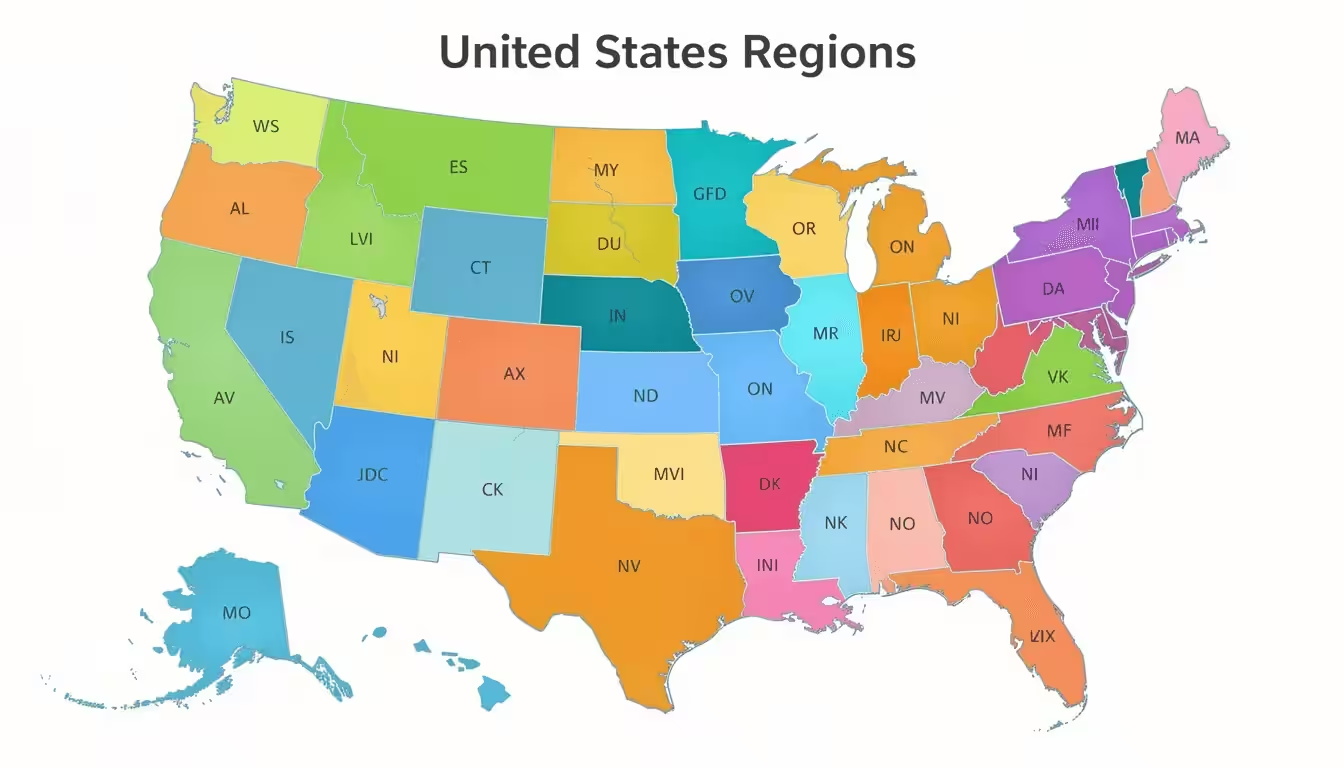
Rather than presenting a complete 50-state table, here’s how states generally cluster by common statute of limitations lengths for typical consumer debts like credit cards and personal loans:
States with 3-Year Limitations Periods
These states offer some of the strongest consumer protections against stale debt lawsuits:
- Alabama
- Alaska
- Kansas
- Maryland
- Mississippi
- New Hampshire
- North Carolina
- South Carolina
In South Carolina, for example, the 3-year limit applies to most open accounts and many written contracts, making it difficult for debt buyers to pursue old accounts through the courts.
States with 4-Year Limitations Periods
California, Texas, and several other states use a 4-year window for many contract actions:
- Arizona
- Arkansas
- California (4 years for credit cards under recent reforms)
- Colorado
- Nevada
- Pennsylvania (for most contracts)
- Texas
- Utah
California’s AB 2831, enacted in 2021, specifically shortened the limitations period for consumer credit card debt to 4 years, down from longer periods that previously applied to some written contracts.
States with 5-Year Limitations Periods
A middle ground exists in several states:
- Florida (for written contracts)
- Iowa
- Kansas (for written contracts)
- Kentucky
- Louisiana
- Missouri
States with 6-Year Limitations Periods
Many states in the Northeast and Midwest allow longer periods for many contract types:
- Connecticut
- Maine
- Massachusetts
- Michigan
- Minnesota
- New Jersey
- New York (N.Y. C.P.L.R. § 213(2))
- Ohio (for many contracts)
- Washington
- Wisconsin
- Wyoming
Important disclaimer: Exact time limits depend on the type of contract, how your state classifies credit card debt (as a written contract or open account), and whether recent law changes apply. Some states like Rhode Island and West Virginia have periods extending to 10 years or more for certain written contracts. Always check current state statutes or consult legal counsel before making decisions based on these general categories.
Common Statute of Limitations Ranges for Consumer Debts
While every state is different, clear patterns emerge across the country for common consumer debts such as credit cards, auto loans, personal loans, and medical bills.
Typical Ranges by Debt Type
| Debt Type | Common Range | Notes |
|---|---|---|
| Credit cards | 3-6 years | May be classified as open accounts or written contracts |
| Medical bills | 3-6 years | Often treated as open accounts |
| Auto loans | 4-6 years | Written contract rules usually apply |
| Personal loans | 4-6 years | Depends on whether oral or written |
| Promissory notes | 6-15 years | Often longer than general contracts |
Many states distinguish between oral and written agreements, with written contracts receiving longer limitation periods. For example, a state might have three years for oral contracts but five or six years for written ones.
Federal law like the Fair Debt Collection Practices Act does not set these timelines—they are purely a matter of state law. The FDCPA regulates collector behavior but leaves limitation periods entirely to the states.
Some states have special statutes for:
- Store-branded credit cards
- Retail installment contracts
- Auto loan deficiencies after repossession
- Medical debt (in some states, recent reforms have shortened periods)
These special rules can shorten or lengthen the default periods beyond the general contract rule. Illinois, for instance, has specific provisions governing retail installment sales that differ from general contract limitations.
Zombie Debt and Time-Barred Debts: How Old Debts Come Back to Life
Zombie debt refers to very old, often time-barred debts that have been sold, resold, or revived—and that collectors attempt to collect even though they may be too old to sue on successfully.
Where Zombie Debt Comes From
Typical sources include:
- Charged-off credit cards from the early 2000s or 2010s
- Old medical bills from treatments seven years ago or more
- Ancient telecom accounts from carriers you barely remember
- Accounts supposedly wiped out in prior settlements or even bankruptcy but still traded in error
- Personal property financing that was never fully resolved
According to 2023 data, debt buyers purchase portfolios of charged-off accounts for as little as $0.01 to $0.05 per dollar owed. This creates strong financial incentives to pursue even ancient accounts—if they can collect even a fraction, they profit.
Common Zombie Debt Tactics
Collectors pursuing time-barred debts often use these approaches:
- Age concealment: Contacting consumers about accounts more than seven years old without mentioning the debt’s age, hoping they don’t know about limitations laws
- Payment trap: Asking for “good faith” payments or small settlements that can restart the statute of limitations in states where partial payment revives claims
- Empty threats: Threatening or implying lawsuits or wage garnishments when the debt is time-barred, which may violate the FDCPA
- Credit damage claims: Suggesting the debt will hurt your credit score when it may already be too old to report
Here’s a concrete timeline example: A credit card last paid in 2012 in a 3-year statute of limitations state (like North Carolina) was plainly time-barred for suing by 2015. Yet a debt buyer might still contact the consumer in 2024, hoping they’ll pay voluntarily or accidentally restart the clock.
A 2022 Federal Trade Commission report documented over 15,000 annual complaints about zombie debt tactics. A 2024 Pew study found that 1 in 10 Americans face zombie collections averaging $5,200 in claimed balances.
Credit Reporting vs. Lawsuit Deadlines
The age of a debt for credit-reporting purposes (generally seven years from first delinquency under the Fair Credit Reporting Act) is completely separate from the age for lawsuit purposes. Zombie debt can remain collectible informally even after it drops off your credit report.
Never agree to pay, acknowledge, or admit that a very old debt is yours before confirming whether it is time-barred in your state. A single verbal admission could create complications, and a payment could restart your legal exposure entirely.
Risks When Debt Collectors Chase Time-Barred Debts
Time-barred debts present particular dangers because collectors may push consumers into mistakes that reopen legal liability. Understanding these risks can help you avoid costly errors.

Key Risks to Watch For
- Restarting the statute of limitations: Making a small payment, acknowledging the debt in writing, or signing a new payment agreement can revive old claims in many states. What seemed like a $50 goodwill gesture could expose you to a $5,000 lawsuit.
- Default judgments: If you ignore a lawsuit on a time-barred debt, you lose the chance to use the limitations defense. A 2023 study by the National Consumer Law Center found that 70% of consumers sued over debt lose by default simply for failing to respond.
- Aggressive collection tactics: Collectors may imply or misrepresent that a debt is still legally enforceable in court, potentially violating the FDCPA or state consumer protection laws. In 2021, a Texas class action resulted in a $3.5 million settlement against a firm pursuing 10-year-old debts.
- New contractual obligations: A written settlement plan can create new contractual liability that can be sued on even if the original account was time-barred.
What Happens If a Judgment Is Entered
Even on an old account, a judgment can result in:
- Wage garnishment (in states that allow it)
- Bank account levies
- Property liens
- Interest accumulating at statutory rates (8-12% annually in many states)
Some states now require collectors to disclose when a debt is time-barred. CFPB Regulation F and specific state statutes in California and New York mandate certain disclosures about time-barred status. However, 39 states still lack such requirements, leaving consumers vulnerable.
If you’re contacted about a very old account, consider speaking with a consumer law attorney or legal aid organization before paying anything or signing paperwork.
Statute of Limitations vs. Credit Reporting Time Limits
Lawsuit deadlines and credit-reporting deadlines are entirely separate systems governed by different laws—state contract law versus the federal Fair Credit Reporting Act.
The Key Difference
Most negative tradelines (late payments, collections, charge-offs) can remain on your credit report for up to seven years from the date of first delinquency. This is true regardless of whether the statute of limitations to sue is 3, 4, 6, or more years.
| Timeframe | What It Controls | Governing Law |
|---|---|---|
| Statute of Limitations | Right to file lawsuit | State law |
| Credit Reporting Period | How long debt appears on report | Federal FCRA |
Example of How These Differ
In a 3-year statute of limitations state, a credit card that went delinquent in 2019 might be time-barred for lawsuits by 2022. However, that same account could remain on your credit report until 2026 (seven years from the original delinquency).
Paying or settling a collection account may update its status (for example, to “paid collection”) but does not restart the seven-year reporting period. The clock for credit reporting runs from the original delinquency date, not from later activity.
Special Rules
Certain account types have different reporting periods:
- Chapter 7 bankruptcy: 10 years
- Chapter 13 bankruptcy: 7 years from filing
- Paid tax liens: Previously 7 years (now removed from reports)
- Unpaid child support: Can be reported indefinitely in some cases
The common misconception that debts “disappear” entirely after either seven years or after the limitations period ends is false. The debt itself continues to exist—only the legal mechanisms for collection and reporting have time limits.
After Moving States: Which Statute of Limitations Applies?
Moving from one state to another can significantly complicate which statute of limitations governs a particular debt. This is an area where many consumers make incorrect assumptions.
Factors That Determine Applicable Law
The statute of limitations that applies to your debt may depend on:
- Where you lived when you opened the account
- Where you resided when you defaulted
- Which state’s law is chosen in the contract (choice-of-law clause)
- Where the lawsuit is actually filed (forum state)
Many credit card agreements name a specific state’s law—often Delaware, South Dakota, or Utah, where financial institutions are commonly headquartered. Courts may apply that state’s statute of limitations even if you’ve moved to a state with a shorter or longer period.
Forum Shopping by Creditors
Creditors sometimes file lawsuits in states with more favorable or longer limitations periods. They may argue that the contract’s choice-of-law provision requires applying a longer deadline, even if you now live somewhere with a shorter one.
Consumers may have the ability to challenge improper venue or choice of law, but this typically requires legal assistance. Courts apply conflict-of-laws rules that vary by jurisdiction, making these cases complex.
A Practical Example
Suppose you opened a credit card while living in California (4-year statute of limitations), then moved to New York (6-year period), and are sued in New York five years after your last payment.
Depending on the contract’s choice-of-law clause and how New York courts apply conflict-of-laws principles, the court might apply:
- New York’s 6-year period (making the lawsuit timely)
- California’s 4-year period (making the debt time-barred)
- The period specified in the contract’s governing law clause
Do not assume that moving automatically shortens or extends your limitation period. The District of Columbia and each state handle these situations differently, and the answer often depends on specific facts and contract language.
What Does “Time-Barred Debt” Mean in Practice?
A time-barred debt is an obligation so old that the statute of limitations to file a lawsuit has expired under applicable state law. Understanding what this means—and what it doesn’t mean—is essential.
What Collectors Can and Cannot Do
In many states, collectors can still ask for voluntary payment on time-barred debts. They simply cannot lawfully win a court judgment if the consumer raises the limitations defense.
However, there’s a critical catch: if you do not show up to court or file an answer, the judge may not know the debt is time-barred. Courts don’t automatically investigate whether lawsuits are filed within the statutory period. Without your defense being raised, the court may enter a default judgment anyway.
Time-barred status is not automatically recognized—it’s a legal defense that must be affirmatively raised. This typically requires filing an answer that specifically cites the expired statute of limitations with evidence of when the limitations period ends.
When Pursuit Becomes Illegal
Under the FDCPA and some state laws, it can be illegal for a collector to:
- Threaten to sue when they know a debt is time-barred
- Imply they can obtain a judgment on a time-barred debt
- Misrepresent the legal status of the debt
A 2019 Kentucky case illustrates these issues. A collector sued on a 12-year-old debt that was clearly barred after 5 years. The case was dismissed only after the consumer raised the defense—but many consumers in similar situations lose by default because they don’t respond.
Concrete Example
Imagine a $3,000 credit card balance with the last payment made in 2014 in a state with a 4-year limitations period. By 2018, this debt became time-barred. A collector calling in 2024 cannot successfully sue you for this debt if you properly assert the defense. But they can still ask you to pay—and if you make even a small payment, you might restart the clock in many states.
What To Do If You’re Contacted About an Old or Zombie Debt
Consumers have significant rights when contacted about very old debts. Proceeding carefully is essential to avoid accidentally reviving a time-barred account.

Immediate Steps
- Do not admit the debt is yours or agree to pay anything immediately
- Request written verification under the FDCPA—you have 30 days from initial contact to dispute and request validation
- Do not make any payment, no matter how small, until you’ve researched the statute of limitations
Reviewing the Information
Once you receive the validation notice:
- Compare the creditor name, account number, and amount with your own records
- Check your credit reports for the account and note the date of first delinquency
- Calculate whether the statute of limitations appears to have expired based on the last payment date and your state’s laws
If you’re unsure about calculation methods or which state’s law applies, consider consulting a consumer law attorney or legal aid organization. Many offer free initial consultations for debt collection matters.
If the Debt Appears Time-Barred
Consider these steps:
- Send a written letter stating you dispute the debt, believe it is time-barred under [your state’s] law, and request no further contact except as legally required
- Send the letter via certified mail with return receipt requested
- Keep copies of all correspondence and detailed notes of any phone calls
- Document the date of every contact attempt
If a Lawsuit Is Filed
Even on a time-barred account, never ignore court papers. You must respond to preserve your right to raise the statute of limitations defense. Failing to respond results in default judgment—and suddenly a time-barred debt becomes an enforceable judgment lasting 10-20 years.
If You Get Sued on a Time-Barred Debt
You must respond to the lawsuit by the deadline listed in the summons, even if you are certain the debt is too old to enforce. This is non-negotiable.
How to Respond
Your answer should:
- Deny liability if you dispute owing the amount
- Specifically assert the statute of limitations as an affirmative defense
- Reference the applicable state statute (such as code ann provisions for your state)
- Attach proof of last payment date or other evidence if available and permitted by local court rules
Getting Help
Contact a consumer rights attorney or legal aid organization quickly. Many offer free or low-cost consultations for debt collection defense. Organizations like the National Consumer Law Center maintain referral lists, and your state bar association may have lawyer referral services.
If the court agrees the statute has expired, the case should be dismissed. The creditor cannot obtain a judgment, and you won’t face wage garnishment, bank levies, or liens from that particular debt.
The Cost of Doing Nothing
If you fail to respond, the court may enter a default judgment. This transforms what would otherwise be a time-barred claim into an enforceable judgment with:
- Potential wage garnishment (where state law permits)
- Bank account levies
- Property liens
- Interest accumulating at court-ordered rates
Winning Through Proper Defense
Here’s how it works in practice: A consumer in Mississippi receives a lawsuit for a credit card with the last payment made in 2015. Mississippi has a 3-year statute of limitations for most consumer debts. The consumer files an answer asserting the limitations defense and provides bank records showing no payment since 2015. The court dismisses the case because the lawsuit was filed in 2024—nine years after the limitations period expired.
Statute of Limitations on Court Judgments vs. Original Debts
Once a creditor obtains a judgment, an entirely different set of time limits applies. These judgment-enforcement deadlines are often much longer than the original debt limitations.
How Long Judgments Last
| State | Judgment Enforcement Period | Renewal Option |
|---|---|---|
| California | 10 years | Yes, renewable |
| New York | 20 years | Yes |
| Texas | 10 years | Yes, renewable |
| Ohio | Up to 21 years | Possible revival |
| Oklahoma | 5 years (some judgments) | Yes, renewable |
| Florida | 20 years | Yes |
Many states allow judgments to be renewed indefinitely, meaning a creditor who obtained a judgment in 2010 could potentially enforce it through 2030, 2040, or beyond.
Why This Matters
The statute of limitations on the original debt stops mattering once a valid judgment is entered. The creditor now relies on judgment-enforcement timelines instead. The alleged offender—in civil debt cases, the debtor—faces long-term collection exposure.
Enforcement Tools Available After Judgment
- Wage garnishment: Ongoing deduction from paychecks (where allowed by state law)
- Bank levies: Seizure of funds from checking and savings accounts
- Property liens: Claims against real estate that must be satisfied upon sale
- Judgment debtor examinations: Court-ordered disclosure of assets and income
Ignoring a lawsuit on an old debt—even one that appears time-barred—can result in a judgment that accumulates interest at high statutory rates (often 8-12% annually) for a decade or more. A $2,000 debt can easily grow to $5,000+ once judgment interest is added.
How the FDCPA and State Laws Protect You on Old Debts
The Fair Debt Collection Practices Act serves as the primary federal law limiting what third-party debt collectors can say and do, including when pursuing time-barred debts.
FDCPA Protections Relevant to Old Debts
- Collectors cannot misrepresent the legal status of a debt (such as claiming they can sue when the limitations period has clearly expired)
- Collectors cannot threaten actions they do not intend to take or cannot legally take
- Consumers can request written validation within 30 days of initial contact
- Consumers can demand in writing that collectors stop contacting them (with some exceptions)
The FDCPA provides for statutory damages of up to $1,000 per lawsuit, plus actual damages and attorney’s fees for violations.
State Law Additions
Many states add extra protections beyond federal law:
- California’s Rosenthal Act: Applies FDCPA-like rules to original creditors, not just third-party collectors
- New York’s debt collection rules: Require specific disclosures about time-barred status
- North Carolina: Consumer credit statutes provide additional remedies
Some states now require explicit notice when a debt is beyond the statute of limitations, warning consumers that making a payment could restart the clock. California and several other states mandate these disclosures.
Example of State Disclosure Requirement
In states with disclosure requirements, collectors must include language like:
“The law limits how long you can be sued on a debt. Because of the age of your debt, we will not sue you for it. If you do not pay the debt, [creditor name] may continue to report it to credit bureaus as unpaid for as long as the law permits.”
Taking Action Against Violations
If you believe a collector has violated the FDCPA or state law, you can:
- File a complaint with the
- Report the conduct to the Federal Trade Commission
- Contact your state attorney general’s consumer protection division
- Pursue private lawsuits for damages (often with attorney’s fees available if you prevail)
Key Takeaways: Protecting Yourself from Zombie Debts
Understanding limitations statutes and your rights under consumer protection laws is your best defense against aggressive collection on time-barred and zombie debts.
What You Need to Remember
Statute of limitations periods range mainly from 3 to 6 years for consumer debts, though some states extend to 10 years or more for certain contract types. The particular state where you live—or where the contract was formed—determines which rules apply.
Time-barred debts still exist and can be collected voluntarily in most states. However, collectors usually cannot legally win a lawsuit if you properly raise the expired statute of limitations as a defense. The debt doesn’t disappear—but the court can’t force you to pay.
The biggest pitfall is restarting the clock. Making payments or written promises on an old debt may revive the statute of limitations in many states. A zombie debt you thought was legally dead can suddenly become vulnerable to lawsuit again.
Your Action Checklist
- Verify debt details in writing using the FDCPA’s validation process
- Check your state’s statute of limitations rules or consult a current 50-state chart
- Determine the date of last payment or default before taking any action
- Seek legal advice before acknowledging or paying very old debts
- Never ignore court papers—always respond and raise the limitations defense
- Document all collector contacts in case you need evidence of harassment or misrepresentation
Whether you’re dealing with personal injury claims that have different limitation rules, motor vehicle accidents, or sexual assault and sexual abuse cases with special rules in the criminal context, time limits matter across all areas of law. For consumer debt specifically, knowing when the limitations period ends can mean the difference between losing money and protecting your finances.
The collectors pursuing zombie debt rely on consumers who don’t know their rights. By understanding the statute of limitations period in your state and the protections available under federal and state law, you can make informed decisions about whether to pay—or whether to assert your right to be left alone about debts that are simply too old to sue on.
If you’re facing collection on an old debt, take time to research before you respond. A few hours of investigation now could save you thousands of dollars—and years of financial stress—down the road.