

Is C2C Resources calling you about an unpaid invoice or a business debt, refusing to say who they are, or calling your coworkers and family about money they claim your company owes? They are commercial debt collector, which makes your rights different from a typical consumer collection case, and figuring out which rules apply to you is the first step. If C2C is calling the wrong person, threatening what it cannot legally do, or pursuing a debt you personally never guaranteed, you may have more protection than you think.
Consumer Rights Law Firm PLLC has been stopping creditor and debt collector harassment since 2010. A+ BBB rated. Call (877) 700-5790 or visit our free case review page. You pay nothing. If a collector broke the law in how it contacted you, they may owe you.
Is This a Business Debt or a Personal One?
C2C Resources collects business-to-business debt, unpaid invoices one company owes another, on behalf of more than 20,000 business clients. The federal Fair Debt Collection Practices Act (FDCPA), the main law that shields consumers from abusive collectors, generally applies only to consumer debt: personal, family, and household obligations. It does not usually cover a straightforward business debt.
Commercial invoice disputes also feature in our A.G. Adjustments guide, including canceled services and disputed business charges.
But the line is not always clean, and this is where many people being called by C2C actually have rights:
- If you are a sole proprietor and the debt is tied to you personally, it may be treated as consumer debt.
- If you personally guaranteed a business debt, your personal exposure can change the analysis.
- If they are calling you as the wrong person, a relative, a coworker, or someone merely listed as a company officer, that contact raises its own issues. Our Allen Maxwell & Silver liability guide explains why a company contact is not automatically a personal debtor.
- Georgia law and other state laws regulate collector conduct even where the FDCPA does not reach.
Our Asset Discovery liability guide also distinguishes business contacts from personal guarantors.
In our practice, the first thing we do with a C2C Resources call is determine whether the debt is truly commercial or whether a personal, consumer, or wrong-party element brings legal protections into play. That single question shapes everything that follows. Our Matthews, Pierce & Lloyd guide also separates commercial accounts from consumer debts before discussing FDCPA protections.
Who Is C2C Resources and Why Are They Calling You?
C2C Resources, LLC is a commercial debt collection agency headquartered in Atlanta, Georgia, founded in 2002. The name stands for “Creditor 2 Customer.” It collects overdue commercial accounts receivable for businesses across the United States and internationally, and it holds a Commercial Collection Agency Certification from the Commercial Law League of America.
If they are calling, one of its business clients almost certainly placed an unpaid account with it, claiming your business, or you personally, owe money on an invoice. They are endorsed by several construction and distribution trade groups, so a large share of its accounts involve unpaid bills between suppliers, contractors, and vendors.
C2C markets a tiered approach to its clients. It offers a free accounts-receivable software program it calls Profit Maximizer, an internal tracking system it calls InfoMax, and what it describes as a “Legal Forwarding Edge” that routes stubborn accounts to a network of collection attorneys. In plain terms, if early calls and letters do not produce payment, They can escalate an account toward litigation through forwarding lawyers. That is worth knowing, because it means a C2C matter can move from phone calls to a lawsuit if the debt is valid and documented, which is exactly why verifying the claim early matters.
Our American Recovery Service Incorporated guide explains another collection model involving an attorney network.
When clients come to us about C2C Resources, the call often reaches someone who is surprised to be contacted at all, either because the debt belongs to a business they no longer run, because they were only ever a listed officer, or because they never personally guaranteed the obligation the caller is demanding.
| Detail | Information |
|---|---|
| Full Legal Name | C2C Resources, LLC (“Creditor 2 Customer”) |
| Business Type | Commercial (business-to-business) debt collection agency |
| Headquarters | 1455 Lincoln Pkwy E, Ste 550, Atlanta, GA 30346-2288 |
| Second Location | 3300 W Esplanade Ave, Ste 104, Metairie, LA 70002 |
| Phone | (678) 495-0050, also (866) 495-0050 |
| Website | c2cresources.com |
| Founded | June 5, 2002 |
| Company Contact | Rodney Wild |
| Certification | Commercial Law League of America (CLLA) certified |
| BBB Status | BBB Accredited since 2011; A+ rating |
| Clients | More than 20,000 businesses nationwide and internationally |
For personally guaranteed equipment debt, our Creative Collection guide examines the transaction’s business purpose.
When Are C2C Resources’ Calls Actually Illegal?
Because C2C collects commercial debt, the calls are not automatically governed by the FDCPA the way a consumer collector’s would be. But that does not give them a free pass, and several kinds of conduct can still be unlawful.
If the debt is consumer in nature, or you are being pursued as an individual guarantor or sole proprietor, the full FDCPA may apply, meaning they must identify itself as a debt collector, cannot harass or threaten you, cannot use abusive language, and cannot call third parties about your debt.
Even on a purely commercial account, a collector generally cannot commit fraud, make threats it has no intent or ability to carry out, or engage in deceptive practices, and Georgia state law and general consumer-protection principles still apply. Threatening criminal prosecution to collect a civil debt, for example, is a serious red flag.
Our attorneys evaluate C2C calls for a specific set of problems that show up repeatedly in complaints: a caller who refuses to identify himself as a debt collector, who becomes abusive when asked for documentation, who calls people with no connection to the debt, or who cannot validate the amount claimed. Any of these can cross a legal line depending on the nature of the debt.
Conduct worth documenting includes:
- A caller refusing to identify who they are or what company they represent
- Refusing to provide invoices or proof of the debt when asked
- Calling coworkers, family, or listed officers uninvolved in the debt
- Threatening arrest, criminal charges, or the district attorney over a civil debt
- Leaving sensitive financial details on a shared or public voicemail
- Continuing to demand payment after you dispute that you owe it
C2C Resources Complaints: What People Are Actually Reporting
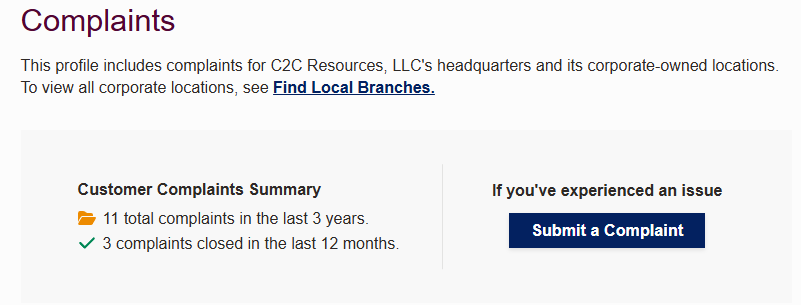
Source: BBB complaints page
C2C Resources is BBB accredited with an A+ rating and shows a relatively small number of complaints, consistent with a commercial agency whose direct customers are the businesses that hire it. The complaints that do appear, however, describe a consistent set of problems from the people being collected against. Here are verified examples from the live BBB complaints page.
- Collector Refused to Identify Himself: A complainant alleged that their representative repeatedly called about a debt but failed to identify himself as a debt collector when asked for documentation. The caller was reportedly rude, hung up during the conversation, and refused to provide company information, telling the consumer to “look it up online.”
- Payment Not Properly Credited After Debt Transfer: A consumer alleged they paid them resources $3,000 toward a debt, but the account was later sold to another company that pursued the full balance. The consumer claimed the payment was never properly applied and has been trying to resolve the issue since 2023. Our Allgate Financial payment guide explains how payments can be missed when collectors change.
- Threats and Contacting Unrelated Third Parties: A complainant alleged their representative accused them of theft, yelled at them, and contacted unrelated individuals connected to the business. Another complaint alleged C2C contacted someone listed as an officer of a company despite that person having no involvement with the debt.
- Threats of Criminal Action Over a Debt: A complaint alleged that their representative threatened to involve the district attorney over an NSF check matter to pressure payment. Using threats of criminal prosecution for a civil debt can raise serious concerns under debt collection laws.
In many of the cases we review, this pattern, aggressive contact spreading to uninvolved people, plus a payment or balance that does not add up, is where a person being called by a commercial collector may still have real legal claims.
Read the complaints yourself on C2C’s BBB profile and BBB complaints page.
Has C2C Resources Been Sued or Investigated?
Public court records show that C2C Resources LLC has been involved in federal litigation, although the cases below were employment-related disputes rather than consumer debt collection lawsuits. Both cases ended without a court ruling on the merits.
- Carter v. C2C Resources LLC:
This case involved allegations of race discrimination under 42 U.S.C. § 1981. The lawsuit was filed on June 13, 2018, against C2C Resources LLC and an individual defendant. The parties later reached a settlement, and the case was dismissed with prejudice on September 11, 2018. The court did not issue a decision on the allegations. - Rudy v. C2C Resources, LLC:
This case involved allegations of employment discrimination based on religion under Title VII of the Civil Rights Act. Filed on December 21, 2012, the case proceeded through initial discovery before the parties filed a stipulation of dismissal. The court dismissed the case with prejudice on July 22, 2013, with each side responsible for its own costs and attorney fees.
These publicly available lawsuits involve workplace discrimination claims, not allegations of unlawful debt collection practices under the FDCPA or TCPA. They provide litigation history for C2C Resources but do not establish violations of consumer protection laws.
How C2C Resources Makes Contact
C2C relies on phone calls, letters, and email, supported by an internal system it markets to clients as InfoMax, which it says gathers information about debtors “from any source.” Its collectors average many years of experience, and the company promotes an approach it describes as professional and litigation-avoiding, though the complaint record from debtors tells a more mixed story.
We frequently see two patterns in C2C contact worth noting. First, calls that spread quickly to third parties, coworkers, listed officers, or relatives, when the collector cannot reach the intended party. Second, a reluctance to put the debt in writing, where a caller pressures for payment but resists providing the invoices or documentation that would let you verify the claim.
Missing invoices and original service records also feature in our American Profit Recovery account-verification guide.
Whatever the nature of the debt, you are entitled to ask who is calling, what company they represent, who the original creditor is, and for documentation of the amount claimed. A legitimate collector can answer all four. A refusal to do so is a signal to slow down and verify before paying anything.
It is also worth remembering that a commercial collector’s leverage depends heavily on your own uncertainty. When a caller keeps a person off balance, refusing to send paperwork, escalating the tone, spreading calls to coworkers, the goal is often to prompt a fast payment before the debt is ever scrutinized. The single most effective response is to insist that everything move to writing. A demand for documentation is not an admission that you owe anything; it is the ordinary, reasonable first step, and it shifts the interaction from pressure on the phone to a paper record you can actually evaluate.
Your Rights When C2C Resources Is Calling
Which protections apply depends on whether your situation is commercial, consumer, or somewhere in between. Our Adams, Stevens & Bradley guide explains why the debt’s original purpose matters when assessing consumer protections.
- FDCPA (Fair Debt Collection Practices Act): Applies when the debt is consumer in nature, or when you are pursued as an individual, sole proprietor, or personal guarantor rather than a business. It requires the collector to identify itself, bans harassment and abusive language, prohibits false threats, and forbids disclosing your debt to third parties. See our FDCPA page.
- TCPA (Telephone Consumer Protection Act): Covers automated and prerecorded calls to your cell phone without consent, regardless of whether the debt is business or personal, at $500 to $1,500 per call. See our TCPA page.
- FCRA (Fair Credit Reporting Act): Applies if a consumer or personally guaranteed debt is reported to your personal credit file inaccurately. You can dispute errors, and the furnisher must investigate, generally within 30 days. See our FCRA page and our guide to disputing your credit report.
- Georgia state law: As a Georgia-based collector, C2C is subject to Georgia’s Fair Business Practices Act, which prohibits unfair and deceptive acts in trade and commerce. Georgia’s statute of limitations on most written contracts is six years and on open accounts four years, after which the debt generally cannot be sued upon.
| Situation | When It Applies | Statute | Possible Remedy |
|---|---|---|---|
| Not identifying as a debt collector | Consumer or individual debt | FDCPA §807 | Statutory and actual damages |
| Threatening arrest or the district attorney | Consumer or individual debt | FDCPA §807 | Statutory and actual damages |
| Disclosing the debt to coworkers or relatives | Consumer or individual debt | FDCPA §805(b) | Statutory and actual damages |
| Abusive or threatening language | Consumer or individual debt | FDCPA §806 | Statutory and actual damages |
| Robocall to your cell without consent | Any debt | TCPA, 47 U.S.C. §227 | $500 to $1,500 per call |
| Deceptive or unfair collection practices | Business or consumer | GA Fair Business Practices Act | Damages; attorney fees |
| A payment taken but not credited | Any debt | State law; possible fraud | Actual damages; restitution |
Fee-shifting matters here. If your situation falls under the FDCPA or TCPA and a collector violated it, the law generally makes them pay your attorney fees, not you. That is why our firm reviews these cases at no upfront cost.
What To Do If C2C Resources Is Calling You
Step 1: Pin down whether this is a business or personal debt. Ask C2C directly whose debt it is, the original creditor, and whether they are pursuing you as an individual or a business. Your answer decides which protections you have. Do not confirm liability until you understand the claim.
Step 2: Demand documentation in writing. Ask C2C to send the invoices or account documents that substantiate the debt. Complaints repeatedly describe callers who resist doing this. A legitimate claim can be documented; put the request in writing and keep a copy.
Step 3: Log every call and note any third-party contact. Record the date, time, number, who called, and what was said. If C2C contacted coworkers, relatives, or people merely listed as company officers, document each instance, because improper third-party contact is often where a claim exists.
Step 4: Protect your payments and your credit. If you pay anything, get written confirmation of how it will be applied, especially given complaints about payments not being credited before a debt was sold. If the account touches your personal credit, pull your reports and dispute any errors, and consider a debt validation letter if the debt is consumer in nature.
Step 5: Report problems and get a free review. File with the FTC, the Georgia Attorney General’s Consumer Protection Division, and, for robocalls, the FCC. Contact Consumer Rights Law Firm PLLC at (877) 700-5790 or through our free case review page to find out whether your situation is protected.
Consumer Rights Law Firm PLLC
Consumer Rights Law Firm, PLLC is a law firm that specializes in helping clients who are facing harassment from debt collectors in any form, including telephone communication. Rather than suffer alone, contact our office to begin the process to stop the C2C Resources harassment. Our office has been assisting consumers since 2010. We are dedicated to providing legal assistance to victims of aggressive collection practices, helping them reclaim their rights and recover funds. We have an A+ rating with the Better Business Bureau.
If you are interested in learning more about how to safeguard yourself and prevent harassment from C2C Resources. call us at 877-700-5790 for immediate assistance or visit our website.
Success Stories
- I’m extremely grateful for the support and guidance I received throughout my case. From start to finish, the team was professional, responsive, and truly cared about my situation. Thanks to their hard work, my case was resolved completely in my favor without any repayment or attorney fees was guaranteed no money payback out of pocket I would highly recommend them to anyone in need of honest and effective legal assistance.
- Amazing working with Matt G. He handled my case quickly and with ease. I got my debt and attorney fees taken care of and off my report. Matt was great at communicating and always made me feel heard. Couldn’t recommend him more!
- I am incredibly grateful to Consumer Rights Law Firm, especially Scott. Initially, I was skeptical because I’m always cautious, but they never asked for any money and were upfront with all the details. I didn’t pay a dime, and the matter was quickly resolved. When Scott called to tell me it was resolved, my response was, “Wow! That was fast!”. I felt relieved. Scott is extremely professional and knowledgeable, making this process so easy. They followed through with everything we discussed, and it was all done in a short period of time. I can’t thank them enough for resolving this matter. I highly recommend Consumer Rights Law Firm.
| 504-837-0529 | 678-495-0050 | 866-955-1755 |
| 504-466-2658 | 678-323-2963 | 866-495-0050 |
| 504-237-0610 |




